An Unconventional Beginning
Coming into university, I no clue that software engineering was a path I would be interested in, let alone a career I would end up pursuing. Part of the reason for this was that, throughout my childhood, I didn't have much exposure to tech. Never got into video games, never built my own PC, never experimented with editing software, and never programmed a functional app. These were all things I'd see peers around me doing and I thought by default, that only those types of people were fit for industries such as software engineering.
However, this all changed as I progressed through my first year of university as a Computer Science and Business Major. Being surrounded by both peers that had already made advancements in the field of tech and also peers with less experience but still possessed the same drive to make an impact made me see not only what accomplishments were possible, but also that there was a path for me to get there as well. It was probably during the summer after first year where I hadn't said it out loud yet, but decided I was going to pursue software engineering.
Early Struggles
I definitely felt lost at times throughout this year, which was also my second year of university. Tech is just such a fast-moving industry and it can sometimes feel like there are an insurmountable number of things to learn. There would be days that go by where I'd be incredibly unmotivated, not because of laziness or procrastination (ok, maybe a bit), but simply because I didn't know where/how to start. Just off the top of my head, some topics I wrestled with: Best ways to learn LeetCode, how to approach full stack dev, and finding the balance between tutorial hell, independent building, and vibe coding. While I knew to ask those around me for guidance, I am also a strong believer that there are just some things you have to figure out on your own, as no two people's path are identical.
Officially Recruiting
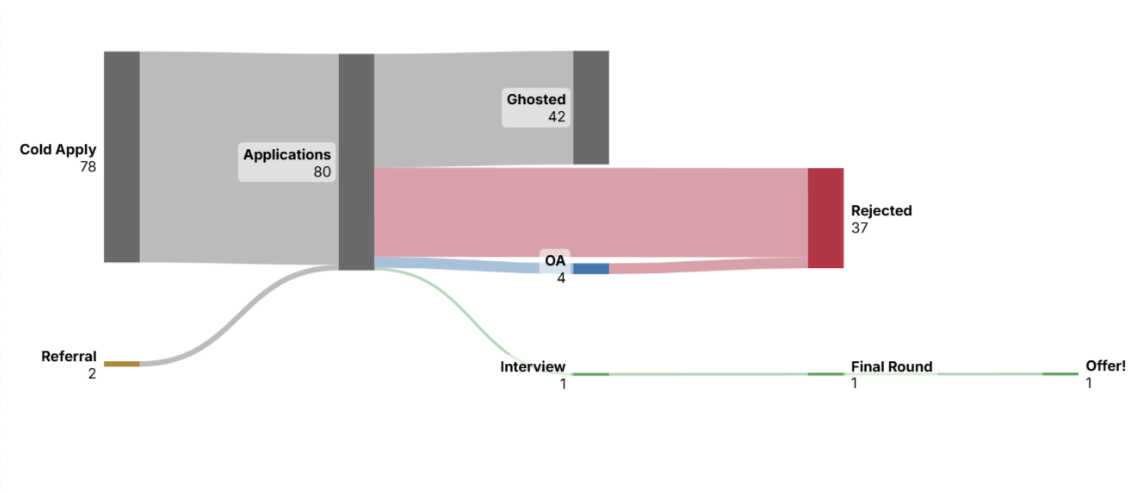
I started applying for jobs in December of 2025 for summer 2026. Knowing I didn't have much experience on my resume, I chose to target Canadian jobs, specifically those in Vancouver and Toronto. I had also made both a Software focused and Product focused resume but the vast majority of applications I sent out were for Software roles. Applying cold, with a resume that wasn't exactly filled with experience meant responses were far from frequent. Apart from a few occasional OA's, the months flew by and I still didn't have any leads heading into April.
Diligent
Diligent opened up their intern posting very late into the summer recruiting cycle, in early April. I was fortunate to be given a referral for the role, and Diligent got back to me the day of, officially entering me into their recruiting process. The timing of this was definitely tough being in the midst of finals season, but this was a role I was very interested in so I gave it my all. My initial recruiter screen was on the 15th, followed by a call with the hiring manager on the 21st, ending with a "technical" round on the 27th with 2 engineers, for 3 rounds of interviewing total. This was a new experience for sure, and I definitely tanked a final exam (or 2), but it was all worth it in the end. As May 1 officially rolled around, I received an offer!
My take (as of now) on Cold Applying
To be honest, I'm not as bullish on cold applying as many others, especially for one's first recruiting cycle. Obviously, my stats weren't great, with exactly a 0% interview rate cold applying. While this was mostly because I didn't send out enough cold applications, just 2 referrals led to an interview and eventually offer. This is not to say that cold applying doesn't work, because I've heard numerous stories of cold applying leading to crazy outcomes but they always require an extensive amount of time and effort that I think would be better spent building relationships. Applications are always temporary, but relationships can last a lifetime. These are just my current thoughts, and this opinion is definitely subject to change as I continue tracking my applications through future recruitment cycles and a career in tech.